Wolf Range Repair
Why a Concord Wolf Burner Sparks and Never Catches
Clicking only proves the spark module is firing; it says nothing about gas arriving where the spark lands. On a Concord Wolf range that sparks and never catches, check cap seating, glazed ports and a wet or cracked electrode before anyone orders a part.
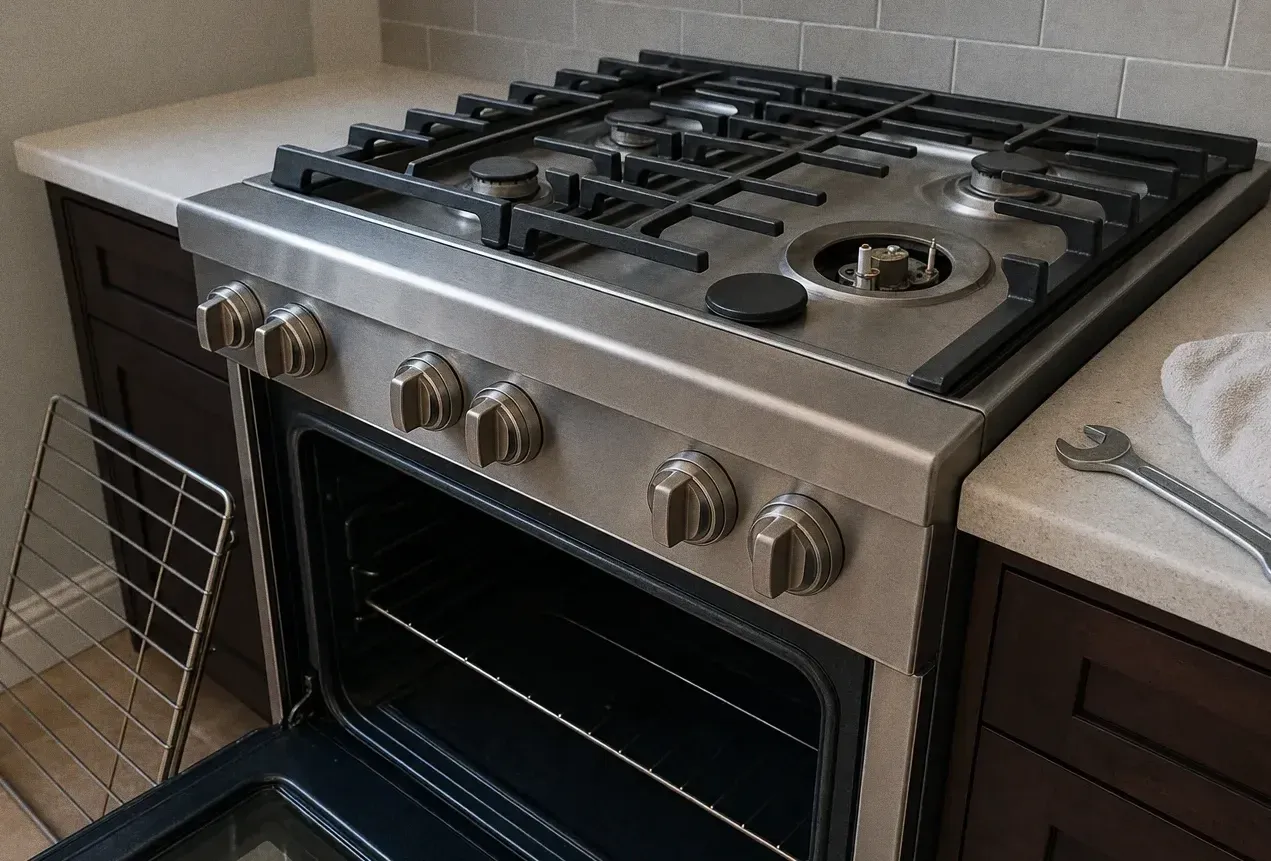
Start with the safety line. Nobody should be diagnosing anything in a room where there is a smell of gas that will not go away. Get everyone out of the house and telephone the gas utility from outside. That call comes first, ahead of any repair company, including this one.
What follows is for a range that clicks away without catching, or that finally catches after a pause, in a kitchen where the air smells perfectly ordinary. The pause is the version worth acting on. A burner that eventually lights has been releasing gas through those seconds while the spark failed to find it, and the soft thump when it goes is that small pocket igniting in one go. Because the burner still works, households in Concord live with it for months — often through an entire autumn of cooking.
The clicking is doing less to help you than it sounds. All it proves is that the module is generating spark on demand. Whether gas is reaching the right place at the right moment is a separate question with a separate answer, and confusing the two sends people out to buy igniters that were never the problem.
One burner, or all of them? Answer that first
Light each position in turn and keep a note of which ones hesitate. A single misbehaving burner puts the search inside that burner: its cap, its port ring, its electrode. Several or all of them misbehaving moves the search to what they share — the module, the gas coming into the appliance, or the earth path the spark system needs.
Expect one confusing observation along the way. Tops of this kind commonly run every electrode from a single module, so asking one knob for spark makes the whole cooking surface click in unison. In an open Conantum kitchen with hard surfaces and a glass wall, that racket sounds like a serious electrical fault and is nothing of the kind.
The exception is sparking that carries on with no knob turned at all. Nothing should fire when nothing has been requested, and that symptom stands on its own rather than joining the list above.
Write down what you find before you start lifting parts off: which positions, when it started, and whether anybody cleaned the top or the grates in the days beforehand. That last question resolves a good number of these without a visit.
The cap, the ports and the last time it was cleaned
Seating is the first thing to verify, because it is the commonest cause and the easiest to get wrong. Each cap has exactly one correct resting position on its base. Sitting slightly high, tipped, or turned off its locating pins is enough to send the gas somewhere other than past the electrode, and the spark will keep snapping into empty air indefinitely.
Test it with everything cold. Lift the cap clear, inspect the seat, and lower it back on without pressure. It should settle by itself and stay flat when you press one edge. A cap that rocks under a fingertip is not seated, no matter how right it looks from standing height.
Blocked ports come next, and around Nine Acre Corner, where kitchens get used for cooking in quantity, they arrive by the potful. Anything sugary that boils over bakes into the slots and sets like glaze. Soak, use a soft brush, and take your time. Never open a slot out with a needle, a paperclip or anything else rigid — those openings are shaped to make the flame behave, and a widened one stays widened.
Moisture is the last of the three and the reason so many of these appear the morning after a thorough scrub. Damp across the electrode or trapped underneath the cap will hold ignition off until every trace of it has gone, and that takes longer than most people allow. Leave the components off and let air circulate around them rather than putting a wet burner back together and blaming the range.
Reading the spark you can see
Dim the kitchen and watch what actually happens. A healthy spark snaps crisp and bright across a short gap, electrode tip to the nearest metal on the burner, one snap per click and always in the same spot. If it wanders, hunts about, or disappears somewhere below the cap, that is your fault.
A cracked ceramic sleeve at the base of the electrode is the classic reason. Concord kitchens with heavy cast grates see this from simple handling — a grate set down carelessly, a pan slid across, a chip nobody noticed. Once that insulation is broken, the spark takes the shorter path through the crack and never crosses the gap it is supposed to cross. The module keeps firing, the clicking sounds entirely healthy, and nothing lights.
Residue does much the same by a different route. A film of grease or cleaning fluid across the ceramic conducts once it is damp, and the spark tracks along the surface instead of leaping the air gap. The cure is a properly clean, properly dry electrode, which is a different job from cleaning the cap.
Either way the lesson is the same: the noise tells you the system is trying, and only your eyes tell you whether the attempt is going anywhere useful.
Where to stop
Repeating the point this article opened on, because it outranks everything else: a gas smell that does not clear means leave and ring the utility from outside.
Beyond that, three findings end the home stage. Ignition still delayed after the cap has been correctly seated and the electrode is clean and thoroughly dry. Sparking that goes on with all controls off. And a burner that lights properly and then dies moments later, which is a fault on the flame-proving side and not an ignition problem at all.
The gas side is not homeowner territory and never becomes so. Valves, the size of the openings gas passes through and the air a burner draws in are all set by design, and adjusting any of them by feel is how a hesitant burner becomes a dangerous one.
What a visit establishes is what nobody can see from the kitchen: the pressure of the gas actually arriving, whether the module fires at the energy it should, whether the switch behind each knob opens and closes when the knob moves, and whether the earth the whole ignition scheme leans on is sound. Kitchens in rear ells around Concord Center often have the range tucked against original masonry with very little room to work, so mention the layout when you book. We cover West Concord, Nine Acre Corner and Conantum, and the details of the work are on our Wolf Range Repair page. Both the phone number and a booking link sit at the top of the page you are reading.
Still asked on the phone
- The burner keeps clicking even with every knob off.
- Treat that as a fault in its own right. The module only fires while a switch asks it to, so continuous sparking means something is holding that request closed — commonly a switch that has failed, or damp that worked its way behind the control panel after a wash-down. Damp sometimes clears on its own; a failed switch never does. Turn the range off at the breaker and arrange a visit.
- Can I clean the ports with a pin or a paperclip?
- Please do not. The openings are sized and shaped deliberately, and a wire pushed through leaves one permanently altered, which shows up later as an uneven flame on that side of the burner. Lift the cap off, soak it, and work at the deposits with a soft brush until they give. Anything that resists soaking is a job for someone with the burner apart.
- I can smell gas. What should I do?
- Leave the house, take everyone with you, and telephone the gas utility from outside. Do not switch anything on or off on the way out, do not try to trace where it is coming from, and do not call a repair company first — that includes us. Once the utility has attended and made the property safe, we can look at whatever the appliance was doing.