Wolf Oven Repair
How to Clean a Wolf E Series Transitional Oven
To clean a Wolf E Series Transitional oven, wipe spills once the porcelain is safe to touch, lift baked-on spots with a razor blade, wash the cavity with mild soap and water, then run Clean and wipe out the ash. Leave the door gasket alone and keep foil off the floor.
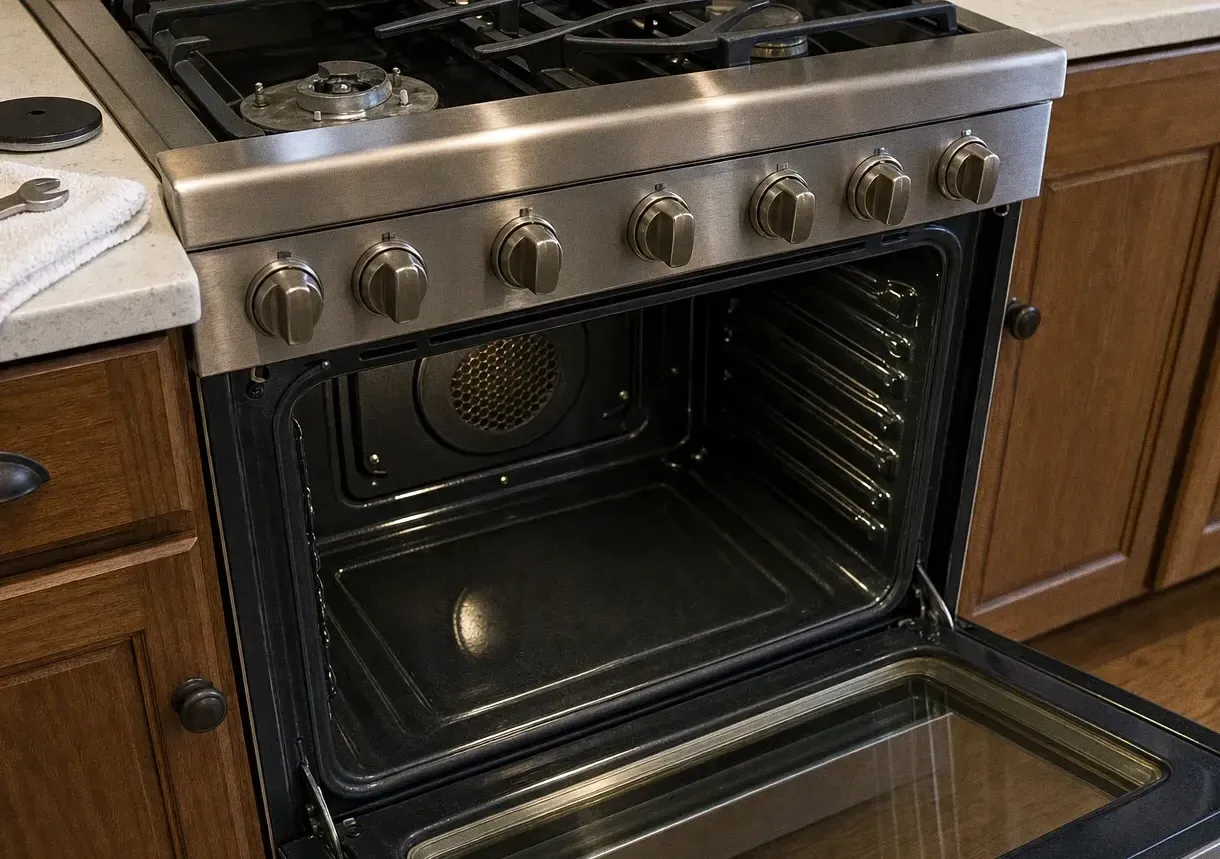
To clean a Wolf E Series Transitional oven, work in two layers. Day to day, wipe spills with a soft cloth and mild soapy water once the cavity is cool enough to touch. When soil builds up, take the racks out, lift crusted spots with a razor blade, wash and rinse the porcelain, then run the Clean cycle with the hood on and wipe out the ash with a damp cloth once the oven has cooled. Two things stay off the list: scrubbing the door gasket, and aluminum foil on the oven floor.
The porcelain lining is the surface you will look at for as long as you own the oven, and the shortcuts that harm it are easy to avoid once you know them.
First, confirm which Wolf oven you have
Wolf’s model numbers tell you what you are dealing with. A wall oven’s number begins with SO for a single oven, DO for a double, or CSO for a convection steam oven. Further along, TE identifies the E Series Transitional and PE the E Series Professional, while TM, PM and CM mark the three M Series styles. Look for the rating label on the oven frame with the door open, or check the paperwork that came with the oven.
It matters because the porcelain-lined E and M Series cavities share one cleaning logic: soap, water, a razor blade and the Clean cycle. A convection steam oven or speed oven in the same wall follows its own rules, covered further down.
Everyday care: the wipe-down and the spills that cannot wait
Most of the work takes half a minute after cooking. Once you can touch the floor safely, wipe drips with a soft cloth and warm water with a little dish soap, then go over the spot again with clean water. On an ordinary day that is all the porcelain needs.
Some spills cannot wait for the weekend. Sugar from a fruit pie, an acidic marinade, or tomato sauce bubbling over a lasagna dish will mark porcelain if left through several heat cycles, and Wolf notes that some of those marks become permanent. They are cosmetic, since the oven cooks just the same, but a pale ring on the cavity floor is there for good. Deal with these the same evening, as soon as the surface is safe to touch.
Skip abrasive powders, steel wool and spray oven cleaners: they scratch or leave a film that bakes onto the porcelain the next time the oven runs hot.
A simple schedule
- After any messy bake: wipe the floor and walls once they are cool.
- Weekly: clean the inside of the door glass and the control panel.
- Monthly: wash the racks by hand and look over the door gasket without touching it.
- When soil covers much of the floor, or the oven smells of old fat as it preheats: run Clean.
Running Clean without hurting the porcelain
Clean is Wolf’s self-clean cycle. It heats the cavity far beyond cooking temperatures until food soil burns down to a light ash, and preparation decides whether the result is bright or stained.
- Let the oven cool fully and take everything out: racks, a baking stone, a thermometer, any pans stored inside.
- Hold a razor blade scraper nearly flat against the porcelain and lift off thick, baked-on spots. Keep the blade low so its corner never digs in.
- Wash the cavity with soap and water, then rinse with a clean damp cloth. Wolf asks for this step because leftover cleaning chemicals can etch the porcelain once the heat climbs.
- Switch on the hood, open a window, then start Clean. The door locks itself and stays locked until the cavity has cooled enough to open.
- After the cycle, give the cavity time to come down to room temperature, then lift the powdery residue away using a moist cloth.
Wash the racks by hand in warm soapy water while the cycle runs; that extreme heat dulls their finish and is hard on the slides of a gliding rack.
Porcelain expands and contracts with every heat cycle, and self-clean is the harshest, so hairline lines, small chips or a cloudy patch can appear over the years. Wolf treats this as cosmetic. If the door refuses to release once the oven has plainly cooled, our guide to a Wolf door that stays locked after self-clean walks through what to check.
In an older Concord house with the kitchen in a rear ell or addition, choose a day mild enough to leave a window open while the cycle runs.
What Wolf tells owners to leave alone
Three instructions in Wolf’s care guidance surprise people, and each one protects a part that is costly to put right.
The door gasket. Do not clean it. That seal around the oven opening keeps heat inside the cavity, and rubbing it, pulling at it or nudging it out of place can break the seal it forms against the door. If a drip lands on it, resist the urge to scrub.
Foil and pans on the floor. Foil spread across the floor or walls, or a pan resting directly on the floor, harms the porcelain and voids the warranty. Put a sheet pan on the lowest rack to catch drips instead.
Spray cleaners inside. Beyond the etching risk during Clean, commercial cleaners leave a residue you then cook over. Soap, water and the blade do the job.
Outside, wipe stainless along the grain with a soft, lightly soapy cloth and dry it. Spray glass cleaner onto the cloth, never straight at the controls.
Other Wolf ovens in the same wall
If your oven wall pairs the E Series with a Wolf convection steam oven or speed oven, those need different care, and none of it involves a self-clean.
The steam oven’s own Clean mode holds 176°F (80°C) for 30 minutes, and a wipe of the interior finishes the job. Its racks and stainless pans are dishwasher-safe, though the water tank is not. Fill the tank with fresh cold tap water, not filtered or distilled, because the oven relies on its minerals. Those minerals build up, so every 6-18 months, depending on water hardness, the display asks for a descale with “Boiler Scaled Up, Please Descale!” Use the whole bottle of Durgol Descaling Solution, part 820021, and never vinegar. The descale takes about 45 minutes and cannot be stopped once it starts.
A speed oven’s racks, risers and turntable go in the dishwasher. Keep chemical oven cleaners out of it entirely, and wipe the waveguide cover on the cavity ceiling without ever taking it off.
When cleaning turns into a repair call
A thorough cleaning is a good moment to notice problems. Call a technician rather than pressing on if:
- the gasket is torn, flattened or hanging loose, or the cabinetry above the door shows heat discoloration;
- the door no longer closes squarely;
- baking times or browning changed after a self-clean, since a sensor can drift (our note on Wolf oven calibration shows how to test it);
- the convection fan grinds, rattles or stops turning.
As typical Greater Boston ranges, door hinge, glass or seal work runs $210–$900 and thermostat or sensor calibration $140–$710, with the firm quote given after diagnosis. The visit is a $95 service call that includes the full diagnosis, and that fee comes off the repair bill if you approve the work. Wolf Repair Concord is an independent service and is not manufacturer-authorized; we work across Concord Center, West Concord, Nine Acre Corner and Conantum. Call (401) 373-4040, or see our Wolf oven repair page.
Still asked on the phone
- Can I use spray oven cleaner on a Wolf oven?
- No, keep commercial oven cleaners out of the porcelain cavity. Wolf has owners wash the interior with soap and water before running Clean, because chemical residue can etch the porcelain at self-clean heat, and its speed oven instructions rule out chemical cleaners altogether. A razor blade, mild detergent and the Clean cycle handle almost any soil.
- Should I clean the gasket around a Wolf oven door?
- No, the gasket is the one part of the door you should never wipe or scrub. Wolf's instructions warn that rubbing or shifting it can spoil the seal it makes against the door. If it looks torn, flattened or loose, have it inspected rather than trying to repair it yourself.
- Is it all right to line the bottom of a Wolf oven with foil?
- No, foil on the floor or side walls damages the porcelain interior and voids the warranty, and the same goes for setting cookware directly on the oven floor. To catch drips, put a sheet pan on the lowest rack instead.
- Why are there fine lines in my Wolf oven porcelain after self-clean?
- Fine lines, small chips and cloudy patches come from the porcelain expanding and contracting with heat, and the self-clean cycle is the hardest test of that. Wolf describes this as cosmetic rather than a fault, and it shows more in a colored cavity. It does not change how the oven cooks.
- Is smoke normal the first time a new Wolf oven heats up?
- Yes, some smoke and odor is expected on the first run. On an M Series oven, the first-use routine is a wash of the interior using hot water and a mild detergent, followed by one hour of Convection Roast at 500°F (260°C) while the hood runs. Follow the first-use steps for your own model and keep the hood running.