Wolf Oven Repair
Wolf Oven Calibration: Testing Why It Runs Hot, Cold or Slow
Wolf oven calibration is a settings-menu offset that corrects an oven that is off by the same amount every time, so confirm that with a thermometer test at 350°F first. Slow, uneven or missing heat points to a sensor, element or igniter instead.
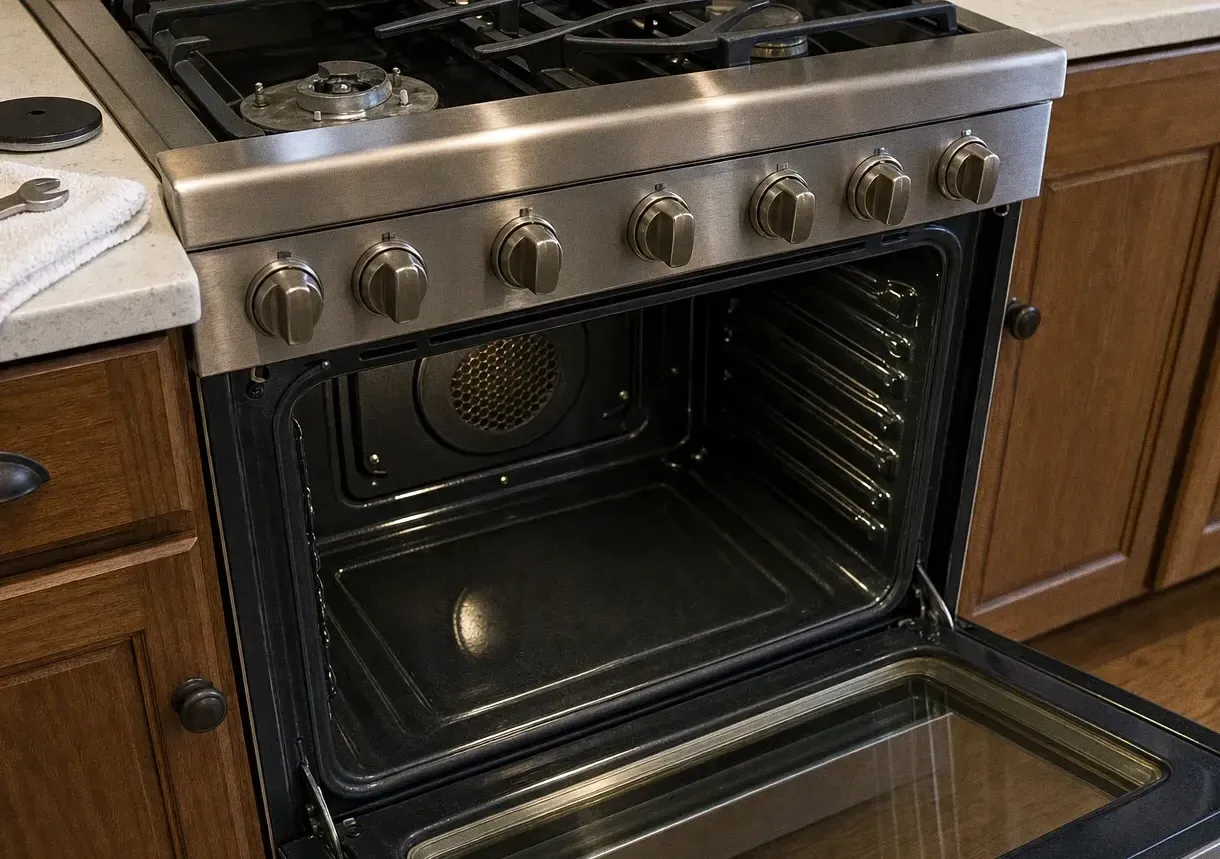
Wolf oven calibration is a small temperature offset, set in the oven’s own menu, that makes the display agree with the heat inside the cavity. It fixes exactly one thing: an oven that is wrong by the same amount every time. So test before you adjust. Put an oven thermometer on the middle rack, bake at 350°F, and read it for half an hour after the preheat signal. A steady 25 degrees off is a calibration job. Slow heating, wide swings or no heat at all mean a part is failing, and no offset will cure that.
Run a thermometer test first
The display shows what the oven believes, so you need a reading that does not come from the oven itself. A basic oven thermometer from any hardware store will do. Stand it in the middle of the center rack, clear of the side walls and the convection fan.
Use a plain bake mode rather than convection, because the fan stirs the air and blurs the result. When the preheat signal sounds, wait another 20 minutes: the air gets hot before the walls and racks do, and early readings run low. Then check the thermometer every ten minutes for half an hour, through the window with the light on if you can.
Average what you wrote down. Every oven drifts above and below its set point as the heat cycles on and off, so a single reading 15 degrees high tells you nothing on its own.
Reading the result
An average within about 10 degrees of the setting is normal. Leave it alone; no recipe is that fussy.
An average 20 to 35 degrees off, repeated by roughly the same margin when you test again at 425°F, is the case calibration was made for. The sensor is consistent, just not accurate.
Other patterns point to parts. Readings that jump 50 degrees between checks suggest the sensor or a relay on the control board. An oven that holds 350°F but falls well short at 450°F often has a weak element, or on gas a burner that is not getting full flow. A preheat that has stretched from about 15 minutes to 30 usually means an element, igniter or door seal. And an oven that keeps climbing past its setting should be turned off and left off, because a relay stuck closed will not stop heating by itself.
Setting the offset yourself
Wolf ovens with a touch display keep this under settings, usually labeled temperature calibration. Older knob-controlled models use a button sequence that differs by model and year, so find the manual matching the model number on your rating plate before pressing anything.
Adjust in the direction the thermometer showed: an oven averaging 325°F on a 350°F setting needs the offset raised by 25. The adjustment range is deliberately narrow. If you need more than it allows, or the oven wanders off again within months, the sensor is drifting and the offset is only hiding it. Repeat the test after every change.
How to preheat a Wolf oven and know it is ready
Choose the mode, set the temperature and wait for the signal. Touch-display models show the cavity temperature rising and sound a tone at the set point; knob-controlled ranges use an indicator light on the panel instead. At 350°F, expect something like 15 to 20 minutes.
The signal means the air is hot, not the whole oven. For bread, pastry or anything tightly timed, give it another 15 to 20 minutes so the walls and racks can hold their heat when a cold tray goes in. Position the racks before you start. And treat a preheat that has doubled in length as a symptom, not a quirk of the oven.
The parts behind slow, uneven or no heat
The temperature sensor is a thin probe on the back wall. Its resistance rises with heat, and the control reads it to switch the heating on and off. Once it drifts out of specification it misreads unevenly, which is why it shows up as swings rather than a tidy offset.
Many Wolf electric and dual-fuel ovens hide the bake element under the floor, so you cannot watch it fail. With the lower element gone, the oven heats from the top only: slow preheat, pale bottoms, dark tops. A stopped convection fan makes one side of a tray brown faster than the other.
All-gas ranges light the oven burner with a glow-bar igniter that has to draw enough current to open the gas valve. A weak one still glows, but the flame arrives late or never, and the oven stalls at lukewarm. Cooktop burners that click without lighting are a separate fault, covered in why a Wolf burner sparks and never catches.
Two causes sit outside the heating parts. A tired door gasket leaks heat and leaves the front of the cavity colder than the back. On a dual-fuel range, a fault on one leg of the 240-volt supply can keep the display lit while the elements stay cold.
When to call, and what it typically costs
Call if the oven will not heat, overshoots, shows an error code, trips a breaker, or still reads wrong after an offset. If you smell gas, touch no switches: leave the house and phone the gas utility from outside.
Coming out to you costs $95, flat, and that figure covers finding the fault; approve the work and it is deducted from the repair. Typical ranges, with a firm quote once we know the fault: thermostat or sensor calibration work $140–$710, igniter $270–$670, convection fan or motor $320–$880, control board or touch panel $520–$1,670, and door hinge, glass or seal $210–$900. Replacement parts on a Wolf oven are factory-approved ones.
Call (401) 373-4040 or book online for Wolf oven repair in Concord Center, West Concord, Nine Acre Corner or Conantum.
Still asked on the phone
- How do I calibrate a Wolf oven?
- Open the settings menu on a touch-display model, find temperature calibration, and raise or lower the offset by the gap your oven thermometer measured. Knob-controlled models use a button sequence given in the owner's manual for that model. Repeat the thermometer test at 350°F after any change.
- Why is my Wolf oven not heating up?
- The usual causes are a failed bake element, a weak igniter on an all-gas range, a faulty temperature sensor or a relay on the control board. On a dual-fuel range, check the breaker too, because a fault on one leg of the 240-volt supply can leave the display working with no heat at all.
- How do I know when my Wolf oven is preheated?
- Touch-display Wolf ovens sound a tone and show the set temperature once preheat is complete, and knob-controlled ranges use an indicator light on the panel. For baking, wait another 15 to 20 minutes after the signal so the walls and racks are fully heated.
- How long should a Wolf oven take to preheat?
- Roughly 15 to 20 minutes to reach 350°F is typical. If yours now takes twice as long as it used to, suspect a weak element or igniter, or a leaking door seal, rather than the calibration setting.
- Is a Wolf oven that runs hot dangerous?
- A few degrees high is not, but an oven that keeps climbing past its setting may have a relay stuck closed on the control board. Switch it off at the control and at the breaker, leave it off, and have it diagnosed before cooking with it again.